
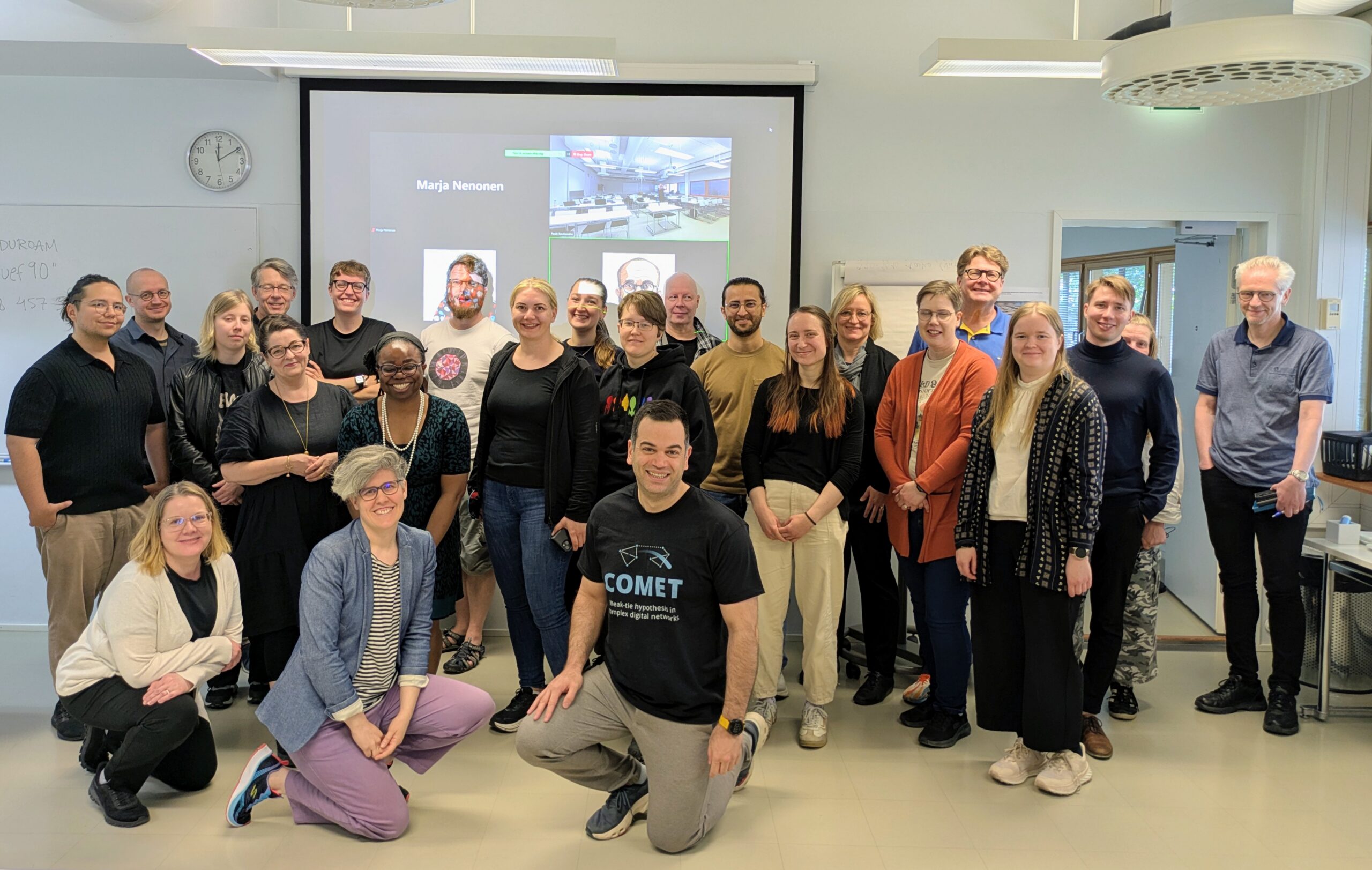
The summer edition of the FIN-CLARIAH travelling seminar married historical and contemporary phenomena by focusing on the relationships between digital materials, from texts to multimodal content, their creators, and the communities that emerge around them. The DARIAH-FI node at UEF hosted some 25 FIN-CLARIAH partners and local researchers to a night-less encounter in Joensuu on June 11-12. This blog summarises a handful of talks that cover diverse research approaches to networks and communities, opening up their infrastructures, challenges and needs.
The first keynote Letter networks and the problem of aliases delivered remotely by Ruth Ahnert (Queen Mary University London) took us back to the notoriously unstable Tudor Dynasty in 16th century England. Their history reminds us that conspiracies and avoiding surveillance are not recent phenomena derived from NSA and Cambridge Analytica data leaks and scandals. Starting with 130.000 state letters from that era, Ahnert [1] reveals the nightmarish task of loyalist officials (and contemporary historians), to reveal the identity and trajectories of conspirators who orchestrated their plots in ink on paper. They covered their tracks by means of aliases –i.e. false initials, pseudonyms, changing signatures or opening their letters with “Dear intelligence sir…”.
Sebastian and Ruth Ahnert have developed a methodological toolkit [2], which does not fully solve the alias enigma, but enables researchers to create a shortlist of candidates from these aliases by scrutinising recurrent identifiable recipients and their networks, to then proceed with verification leveraging hints in the letters –such as handwriting or stylistic mannerisms.
Jumping centuries ahead to the contemporary Finnish political establishment, UEF’s own Tuija Saresma’s talk Making sense of hate speech reported about another kind of nightmare for public personas, victims and sadly, at times, perpetrators of hateful verbal abuse. Hate speech (HS) can be defined as communicative situations that “violate an individual’s dignity, or promote intolerance, racism, misogyny, or homophobia”. Despite its visibility, it is difficult to narrow this multifaceted phenomenon to a specific set of words that could point at symptoms and effective antidotes. Equally challenging remains to discover the identities of haters, the mechanisms that spread hate, or the connections between occurrences, experiences and effects (both at individual level or in society at large).
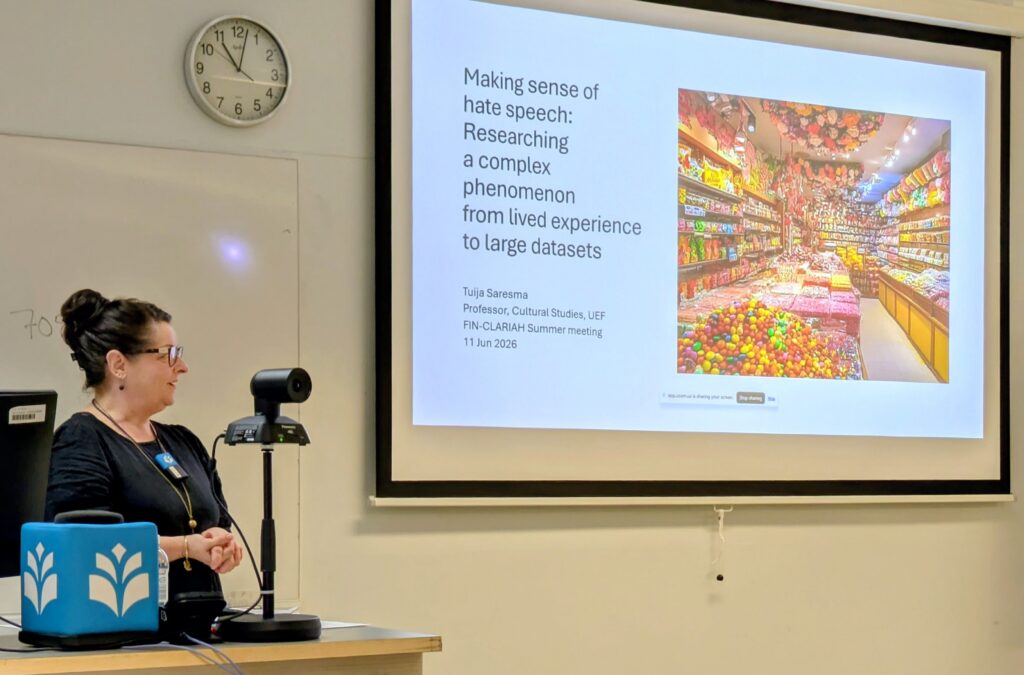
Saresma recapped two reports of her group’s hate speech research [3, 4], to propose a multi-method antihate toolkit. It includes sophisticated digital methods and incomprehensible visualisations but above all, it consists on 1) distributing observation across platforms to acknowledge HS’s multifaceted and multimodal nature, 2) reaching out to the largest possible number of people affected with anonymous surveys which allow to tell something representative about HS’s prevalence, and 3) facilitating the bravest to revisit their experience reflecting upon the ramifications of consequences. Saresma recognises that each set of data produces results that might contradict each other and require careful contextualisation. Sadly, cons are not entirely due to the complexity and diversity of research data, but it also comes with a price. Indeed, social media moguls monetise on freely provided data selling it out to researchers or companies; but also researchers are under considerable strain being by being exposed to visual and discursive evidence, or falling victims of hate speech in environments where de-contextualisation, and personal judgement expressed as matter of fact have become commonplace.
The seminar programme was completed by a insight talks by DARIAH-FI nodes that revealed to my own amazement the diversity of all that can be leveraged to expose complex phenomena and networked communities.
Continuing our time travel, Ville Vaara from the University of Helsinki ComHis group, returned us to Britain, this time to the blooming 18th century publishing industry [5]. Focusing his talk on text-reuse across a massive dataset including numerous full-text editions of The History of England [6], Vaara unveiled this rather overt plagiarism as a common strategy to satisfy growing demands of a burgeoning reading society –or perhaps victims of exuberant but fashionable collecting habits. Following “uncredited references”, it is possible to expose what ideas were original, or who were the lazy intellectuals and true influencers of the time.
From Aalto University’s Semantic Computing group, Henna Poikkimäki revisited sources popular for historians and history-buffs alike. A tightly networked society can be explored through the private correspondence of 19th century socialites gathered in LetterSampo. Or, for example, academic networks in the capital can be explored combining university matriculation registers (AcademySampo) and personalities’ biographies (BiographySampo), both systematically collected since the 1700s. Network visualisation is a feature common to many Sampo portals, but more importantly, it will soon be possible to examine their content together in the mother of all Sampos currently under development.
To button-up this recap, Masoud Fatemi from the COMET research group (UEF), took us back to the present with a glimpse into his recently published thesis [7]. Fatemi has leveraged millions of Tweets enriched with geographical, language or gender parameters, and so called NSI (an index that indicates the strength of a network), to compensate the brevity of content in social media such as X or Bluesky. His methodological proposal is to explore and attach metrics to ego-networks to better understand the social structure behind the diffusion of innovations. The talk included insights on the soon-to-be released DNS, a corpus that triples the NordicTweetStream, and will include benchmark data from UK, US, Australia and X’s replica, Bluesky.
By collecting under one roof these diverse starting points, temporally and thematically distributed approaches, a relay is now given to you, dear intelligence sir or madam, to ponder and reach out the abundance of experts in Finland that offer support in exploring constellations of communities and their networks.
[1] Ahnert, R., & Ahnert, S. E. (2023). Tudor networks of power. Oxford University Press ISBN- 9780198858973
[2] Ahnert, R., & Ahnert, S. E. (2019). Metadata, surveillance and the Tudor state. History Workshop Journal, 87, 27–51. https://doi.org/10.1093/hwj/dby033
[3] Knuutila, A., Kosonen, H., Saresma, T., Haara, P., & Pöyhtäri, R. (2019). Viha vallassa: Vihapuheen vaikutukset yhteiskunnalliseen päätöksentekoon. Valtioneuvoston kanslia. https://urn.fi/URN:ISBN:978-952-287-786-4
[4] Saresma, T., Pöyhtäri, R., Knuutila, A., Kosonen, H., Juutinen, M., Haara, P., Tulonen, U., Nikunen, K., & Rauta, J. (2022). Verkkoviha: Vihapuheen tuottajien ja levittäjien verkostot, toimintamuodot ja motiivit. fi=Valtioneuvoston kanslia|sv=Statsrådets kansli|en=Prime Minister’s Office|. https://urn.fi/URN:ISBN:978-952-383-298-5
[5] Vaara, V. (2025). Charting the Circulation of Histories of England: A Computational Approach to Literary Borrowing in Enlightenment Britain. In M. Hanvelt, M. G. Spencer, & M. Tolonen (Eds), Enlightenment Histories (pp. 37–72). De Gruyter Oldenbourg. https://doi.org/10.1515/9783111637181-003
[6] Gale Group / InfoTrac. (1702). ECCO – Eighteenth Century Collections Online (Gale). Gale Group. https://go.gale.com/ps/start.do
[7] Fatemi, M. (2026). Computational methods for analysing Twitter-based social networks. Itä-Suomen yliopisto. http://urn.fi/URN:ISBN:978-952-61-6013-9
Summary and photos by: Inés Matres