
How will I capture this moment? Multiple times I have asked myself this question. As ethnographer I have witnessed emotional moments. While doing fieldwork in a history class, students closed a month-long review to Europe’s colonial history with several minutes of silence; “kids are struggling with this, all are looking at their desks, faces look as if they were having trouble swallowing or stomach ache” is jotted in my field diary. On other occasion, during an interview with a history teacher, I added the following annotation in a transcript “closes hand into fist” as immediate reaction to my question of how he was coping with all the digital competence they were supposed to be teaching. On emotional moments, my modus operandi is always the same, quick glance at the recording time, and as soon as the mood shifts, I jot what I saw. Expressions of emotion are among the most valuable findings qualitative researchers encounter and return to.
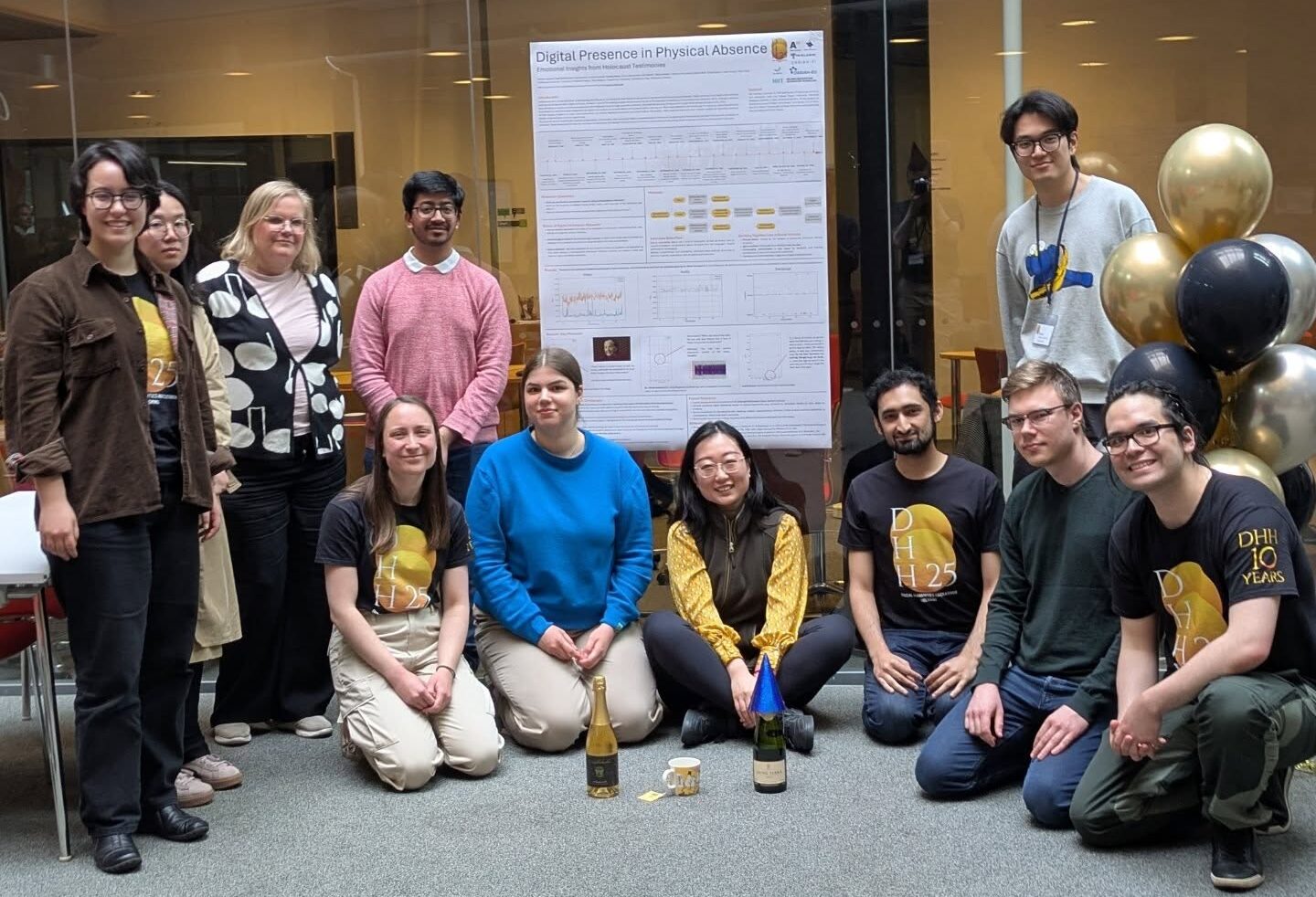
This was the first hunch nine students in a preparatory session for the last Hackathon in 2025. We asked them quite openly what did they want to do with 100 interview-recordings of Holocaust testimonies. They wanted to understand their emotions, and immediately, a practical question emerged: How to find these moments?
Spring 2025 marked the 80th anniversary of the end of Terror in Europe. After concentration camps were liberated, survivors and witnesses went on living. Some silenced forever, others came forward with their testimony of what they saw and experienced. Thousands of hours of video recordings bare witness to any descendant and researcher who dares looking. A place to start, is the database collated by the US Holocaust Memorial Museum. A recent article in Der Spiegel features Germans who have dared search their family name in a newly released database of Nazi Parteikarten confiscated by Allied Forces and kept at the US Federal Archives. This impulse to look back, confirms that personally or collectively, memory always needs to be returned to and processed.
To mark the anniversary of last year’s Hackathon project Emotional Insights from Holocaust Testimonies, I am immensely proud of sharing the fruits of the labor by the Oral History group, specially, of two of these students Nele Mantaj and Vaibhav ‘Vibs’ Agarwal, who had the patience and perseverance to revise the group’s work, organize and clean the group’s documentation. In the article below, we unfold last year’s work into a workflow that proposes a way to go about emotion analysis of interview material. This guide is particularly insightful for interviews found at large-scale and lacking those important bookmarks on emotional moments that indicate to sharpen one’s sensitivity and to pay attention.
Mantaj, N., Agarwal, V., & Matres, I. (2026). Emotions In Oral History Interviews: A Multimodal Approach to Holocaust Testimonies. In LREC 2026 Workshop Proceedings – The Second Workshop on Holocaust Testimonies as Language Resources (HTRes) Workshop proceedings, 66–73. http://lrec-conf.org/proceedings/lrec2026/workshops/htres/2026.htres-1.0.pdf#chapter.8
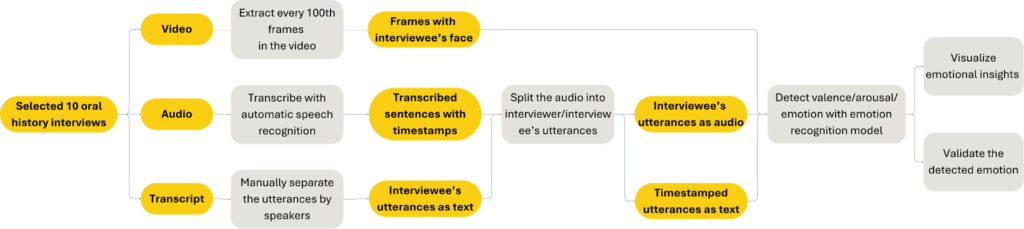
This paper was recently presented at the 2nd Workshop on Holocaust Testimonies as Language Resource (LREC conference), hosted by Isuri Anuradha and Martin Wayne and with support from CLARIN and EHRI (the European Language and Holocaust Resource Infrastructures).
Text: Inés Matres, Photo: Saara Kekki