In this report we gather important references to tools and use cases that illustrate Terminology work as a resource for improving visibility of research outputs and to produce reliable data-analysis tools. These were recently introduced to a small but interested live-audience at Aalto University.
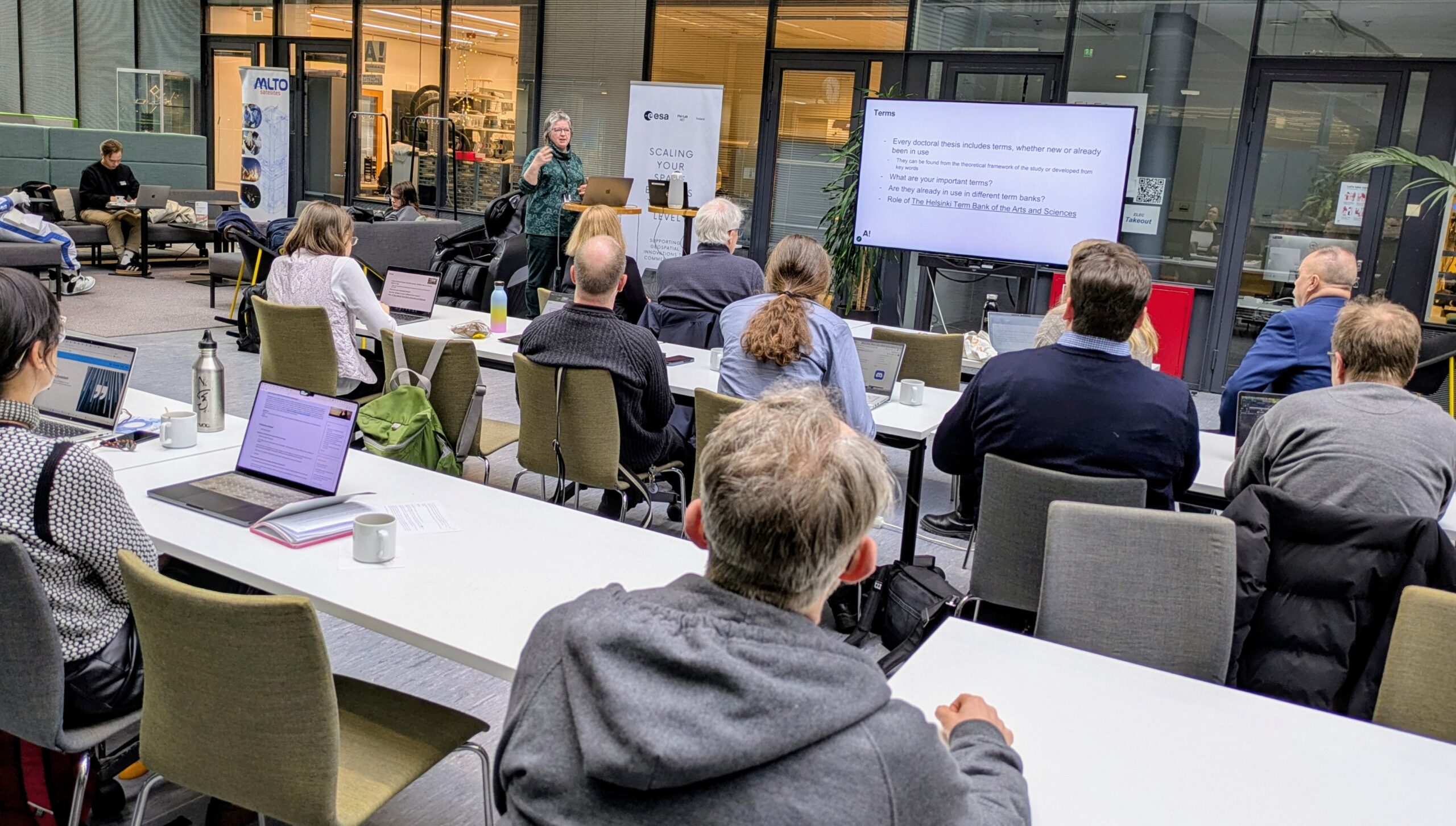
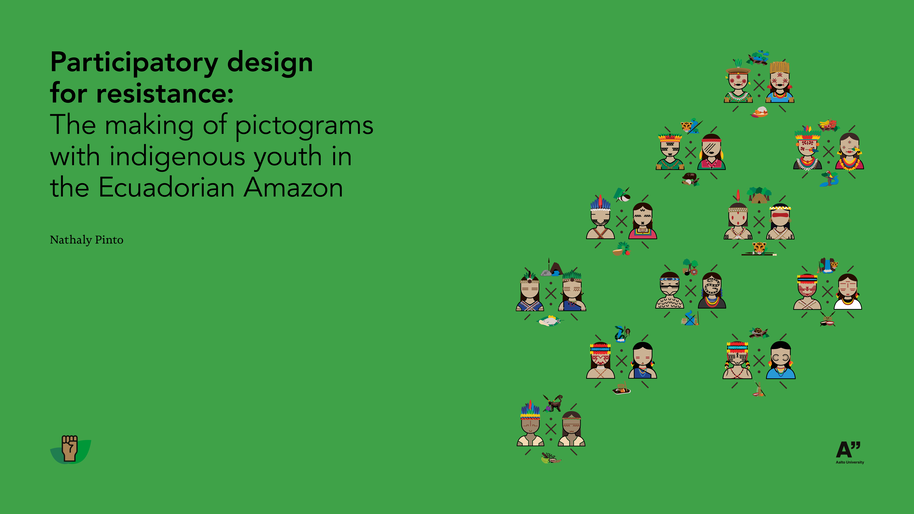
Precisely Aalto was chosen for this event, as it is the first university in Finland to introduce recommendations to contribute scientific terminology descriptions in relation with doctoral research produced in Finland. The recommendation reads that the key terminology of any doctoral thesis (typically 2-3 key terms) should be published alongside its Finnish and/or Swedish terms in the The Helsinki Term Bank for the Arts and Sciences (HTB). In the first part of the event the Head of Doctoral Education Services Minna Söderqvist, and Antti Susiluoto, Planning Officer at the School of Arts, presented the guidelines and support available for local researchers in this task (slides). Harri Kettunen and Nathaly Pinto Torres presented the HTB alongside Pinto’s contributions (slides). In addition to being considered an academic output, contributing to HTB has allowed Pinto to make visible her doctoral research to Finnish academic audiences, and enrich the concept of participatory design (osallistava suunnittelu) with her original approach greatly inspired by design practices in South America with indigenous populations.
In the second part of the event, Osma Suominen (slides) from the National Library of Finland introduced terminology-based infrastructures, for example Annif tool which uses, as Suominen called it “first generation AI”, to provide keywords (including multilingual variations) for any given set of textual data.
Local researchers Annastiina Ahola and Petri Leskinen presented their work with Kirjasampo and Biografiasampo. Both researchers from the Semantic Computing Research Group have collaborated in developing user-friendly interfaces that enable exploring a wide range of available cultural heritage data. Kirjasampo gathers under one roof publication information on all Finnish Public Libraries collections. In her talk (slides), Ahola illustrated how this tool enables the exploration of genre distribution across time, for example, while Finnish authors remain prolific in children and juvenile literature, genres such as romantic novels have lost popularity since the 1990s, and a range of differentiated sub-genres have appeared from the typical detective novel or “dekkari”. In turn, Biografiasampo among other things (see slides), makes visible social networks among Finnish historical public figures based on their life-stories collected by the Finnish Literature Society.
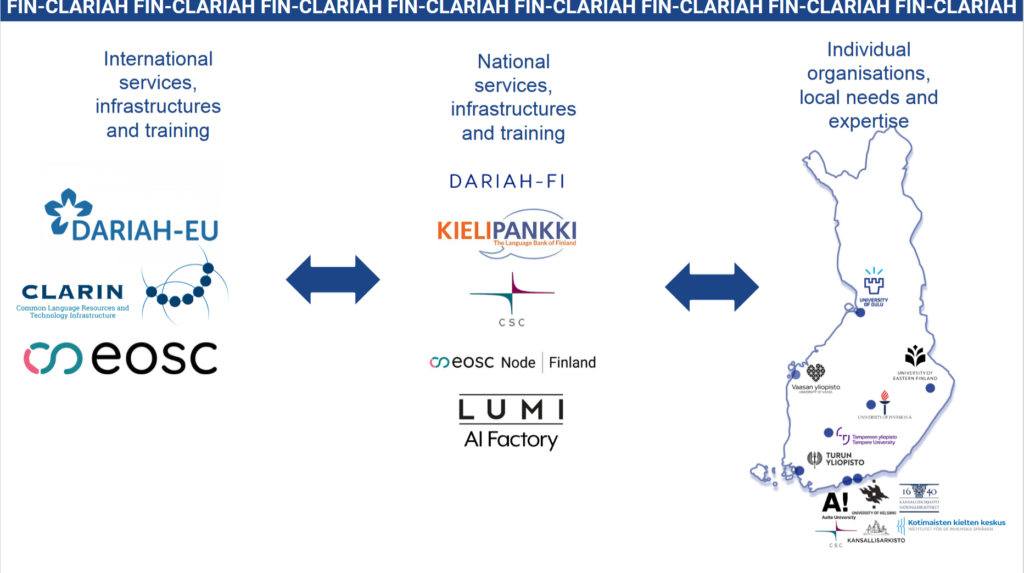
At the event we also brought news about services, tools and collaboration networks offered via FIN-CLARIAH. Eetu Mäkelä, alumni of Aalto and technical leader of DARIAH-FI provided a good snapshot (see above) of the connections across university and national borders enabled by this infrastructure. Later, Mietta Lennes (slides) introduced a central services to find, deposit and share language-related data in Kielipankki – the Language Bank of Finland that hosts a wide range of data e.g. hundreds of hours of spoken Finnish and Finland Swedish donated by citizens through the project “Lahjoita puhetta/Donera Prat”; to a multilingual dataset of 70 mio. tweets from the Nordic Twitter/X, collected in the range of 10 years, alongside their network characteristics and geographical location. Inés Matres provided an overview of the expertise in Finland gathered under DARIAH-FI (slides), a network of multidisciplinary expertise on contemporary and historical cultural and societal phenomena and developing versatile analysis tools to support big data approaches.
Text: Inés Matres, Images from presentations by Nathaly Pinto Torres and Eetu Mäkelä